

Search
User login

Groups
A group on Commtap is a place where you can collaborate, plan, organise, and work on projects. The pages that a group can create can be either public or private to that group (only visible to them). List of groups
Creating a new group
Contact us if you would like to create a new group on Commtap.
"Private" Groups
The idea of private groups is not to have something kept secret, but rather to help people not have stuff in their searches of the site which they won't be able to use.
Share information about self with others
| Activity/strategy name and materials required | How to do the activity | Key principles for doing the activity and comments |
|---|---|---|
| Likes and dislikes Optional - something to record the students responses on (e.g. paper/pen) which can later be used as a prompt; Soft ball or beanbag. |
| To make it harder, you can go around again asking for favourite drinks - so that everyone now has to remember a food and a drink for each student when they pass the ball (e.g "Tim - you like carrot cake and tea"). You could use favourite games, favourite places to go, etc. instead. |
Talk about things in the recent past
| Activity/strategy name and materials required | How to do the activity | Key principles for doing the activity and comments |
|---|---|---|
| What have you done today? Optional - way of recording students responses - e.g. paper/pen, whiteboard/marker |
| Variations
|
| What have you done today - with a ball Optional - way of recording students responses - e.g. paper/pen, whiteboard/marker Soft ball or beanbag |
Starts to greet familiar people using a reward chart system
| Activity/strategy name and materials required | How to do the activity | Key principles for doing the activity and comments |
|---|---|---|
| Says ‘Hello’ to 3 familiar people
If you don't already have a symbol for "hello" you can find one in the Commtap Symboliser.
|
| The length of these instructions show that this is quite a difficult routine to learn! The object of the activity is give the child conventional politeness. Allow time to develop this skill.
|
Develop an awareness that different people have different preferences
| Activity/strategy name and materials required | How to do the activity | Key principles for doing the activity and comments |
|---|---|---|
| I like/ I don’t like Laminated A3 sheet divided in half with a line, with an "I like" symbol on one side and an "I don’t like" symbol on the other side (symbols could be a smiley face and a sad face); Assortment of pictures of food, animals, cartoon characters, games etc.; Use Velcro or blue-tak to attach pictures to board. You can also get picture symbols from the Commtap Symboliser.
|
| |
| Jump in the hoop Large plastic hoop. Assortment of pictures of food, animals, cartoon characters, games etc. (if needed). |
Use "is" to join a noun to an adjective
| Activity/strategy name and materials required | How to do the activity | Key principles for doing the activity and comments |
|---|---|---|
| Sentence Sequencing cards Cards showing a range of nouns and adjectives plus the words "the" and "is". DLTK's examples. (https://www.dltk-kids.com/) Pencil and paper (optional) | 1. Lay the word "is" on the table in front of the child. Put the word "the" to the left of this, with a gap in between them. Check that the child can read both words; 2. Put one of the noun cards into the gap between the words "the" and "is"; 3. Put one of the adjective cards after the word "is"; 4. Read the sentence to the child (e.g. "the monster is green"); 5. Encourage the child to make up new sentences in the same manner. It doesn't matter if the sentences are silly; 6. You can use the paper to record the sentences made, or for the child to draw an appropriate picture on. | Only suitable for children who can read simple single words. |
| What's in the bag? Feely bag containing a range of objects (choose objects appropriate for the children you are working with); "is" cue card as previous activity. |
To make eye contact
| Activity/strategy name and materials required | How to do the activity | Key principles for doing the activity and comments |
|---|---|---|
| Gain visual attention Use something that the person may be visually attracted by, for example:
|
| Remember that although the room needs to have little visual distraction the light needs to be sufficient to allow clear eye contact to be made e.g. a low light sensory room may not be so good for this activity. |
Contribute Activities (advanced)
Key things you can do
Choose one of the following and follow the steps to create or upload something.
Commtap Code Download
HTML to docx Converter (BSD licensed version)
This code is used to power the Word document downloads on this site (example - click on the Word document icon towards the top right of that page). The code is available under a GPL license from https://github.com/neilt1700/htmltodocx.
Contribute Activities
Key things you can do
Choose one of the following and follow the steps to create and/or upload your own activities sheet or upload a file which could be used as an additional resource. For advanced users: you can fill in forms on the site instead of uploading.
Commtap for Speech and Language Therapy Students
This two hour workshop is aimed at Speech and Language Therapy students. We will show students how the site is organised and how to add and edit things on the site. The workshop includes:
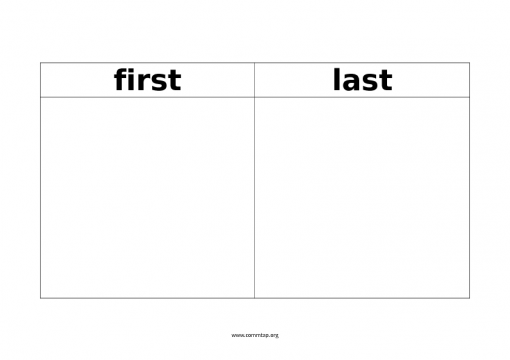
First next last; first last templates
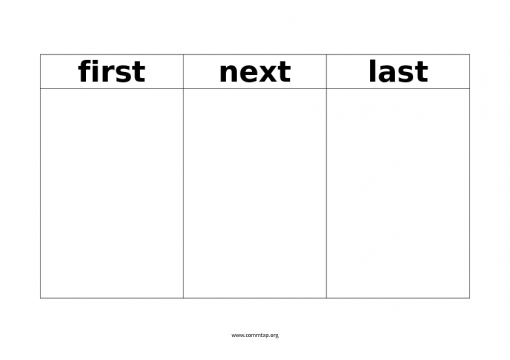
Template to use for first/next/last or first/last sequencing - with space for pictures. Example activities: sequences three pictures with first next and last.
Created 18 October 2012; updated 19 July 2015.
Initiation prompt cards

Examples of prompt cards you could use to help a child initiate - includes the main part of a sentence which the child may need to fill in using a name. Example activity.
Created 18 October 2012; updated 8 December 2015.
Robert's Friend
One day there was a boy called Robert. He was starting at a new school. On his first day, he met lots of children in his class. At playtime, he went outside with everyone else. Some children played football. Some children played hopscotch. Some children ran around and played tag. Robert wished he could play. He didn’t know anybody yet.
Phrases cards for emotions game
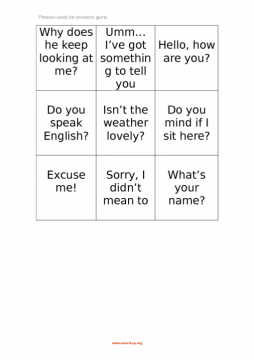




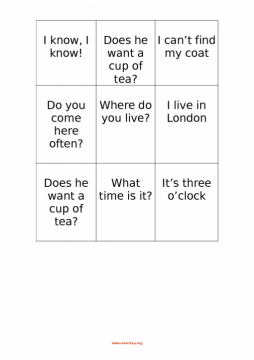
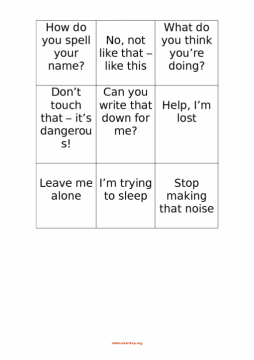
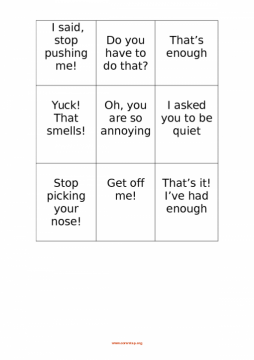
Created 18 October 2012; updated 30 April 2022.
Support Commtap to keep it online
Thank you for visiting Commtap.
Please read this message as it is extremely important.
- Visitor donations mean we can continue to host over 1,000 free activities to support speech, language, and communication development.
- Visitor donations mean we can continue to provide free resources to address a wide range of communication needs, including limited speech or language, interaction challenges, and needs associated with conditions such as developmental language disorder, autism, and cerebral palsy.
- Visitor donations mean we can continue to provide resources to support the work of speech and language therapists, teachers, teaching assistants, parents, and carers.
- Visitor donations mean we can continue to provide the free key word sign dictionary (bks.org.uk) which has over 2,000 Makaton and Signalong signs.
We know that not everyone is able to afford to pay to access these resources, however, if you can, please make a donation to keep the site going.
Thank you

Google ads on this page are provided by Google Adsense - and their presence does not imply any endorsement by Commtap. Report a problem with an ad on this page. Log in (for free) to avoid seeing Google ads.
