

Search
User login
Topic “Activities”
This sheet contains activities.
To develop question skills
| Activity/strategy name and materials required | How to do the activity | Key principles for doing the activity and comments |
|---|---|---|
| Flowchart questions Use one of the pre-made flowcharts or use the blank flowchart to make your own one. You can find these charts on www.commtap.org: Template for creating your own question flowchart: Blank 3 question challenge Pre-made flowcharts: The Animal Challenge, The Food Challenge Labels to write the answers on | Write one answer per sticky label. Stick one of the labels to the back of the child / children. Using the questions on the flowchart, they must work out what the word on their back is. | It works well if you have one answer 'spare' so that each child needs to ask the questions to work out what their word is. |
| Guess who? Game | ||
| '20 Questions' Object cards (optional) | Emphasise that they are working out the answer, not guessing it. It is useful to have prompt questions, or categories on cards for the children to use. E.g. questions such as: How big is it? What colour is it? What do we use it for? Categories can include: animals, toys, furniture. | |
| 'I Spy' with a difference | It is useful to write on a whiteboard what you have found out. Use this to remind the children of what you already know and what you need to find out. |
Talk about a recent event
| Activity/strategy name and materials required | How to do the activity | Key principles for doing the activity and comments | |||||
|---|---|---|---|---|---|---|---|
| News Report Prompt sheet with a series of boxes in order, e.g. | 1. Ask the child to tell you about something they have done, e.g. making a snowman. 2. Encourage them to tell you what they did first, next, next, at the end, using the prompt sheet. | You can use the prompt sheet by pointing to the boxes in order as you go through the event. You or the child could add drawings or pictures into the boxes. | |||||
| Timeline A timeline drawn on paper or a string | Start with what the child has done in the morning or the day. You can move on to longer periods of time. You can do this by using pictures off a visual timetable. | ||||||
| What's in the Bag? Bag Objects to do with a familiar routine, e.g. getting up |
Four word phrases
| Activity/strategy name and materials required | How to do the activity | Key principles for doing the activity and comments |
|---|---|---|
| Act out a simple story with miniature people Use an event retell sheet with columns for 'who', 'what', 'when', 'where'. Simple everyday stories, for example: 'Going to the shops to buy new red shoes, nearly not finding red shoes, happiness at finding them at last' 'going out to play in the rain and jumping in puddles. Mum is cross' 'playing football with Dad and Dad kicks the ball into a tree' 'going on the bus on the bus and loosing teddy. Finding him next day at the bus station'. | Tell a story to the child using miniature people, some eg's in next column. Get the child to retell the story to you. This works well in a small group or in a one to one situation. Use a retell sheet to help the child answer 'wh' questions about the story. The child can write the answers and/or draw a picture. The child can read the story back to an adult. | Remember to give children enough time to produce the language you want. Use the figures or pictures as a prompt to get the language you want. |
| Barrier games Barrier games designed to elicit 4 word phrases e.g. Black Sheet programme | ||
| Books | If a child is struggling say it for the child 'as he would if he could', then ask the child to produce the phrase again without your language model. | |
| Digital camera record of school trips or games in the play ground |
Say sentences using past present and future
| Activity/strategy name and materials required | How to do the activity | Key principles for doing the activity and comments |
|---|---|---|
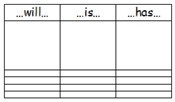
| Sequencing pictures sheet Sheet with boxes labelled "...will...", "...is..." and "...has...":
Simple sequencing pictures showing an action that is about to happen, the same action happening and the action when it is complete, for example Black Sheep Press's 3-step sequencing pack. Alternatively, you could make your own (e.g. take photos of the child, or draw them) or you could print them out from a picture resource such as "Flash-Pro" if you have it, or use other commercially produced sequencing pictures such as LDA or Colorcards. Glue or Blu-tac Pen or pencil | 1. Put the sheet with the boxes labelled "....will....", "....is...." and "....has...." in front of the child and help the child to read the words. 2. Mix up the pictures from one of the sequences. 3. Help the child put them in the correct order, putting them in the correct boxes on the sheet. 4. Ask him/her to describe the sequence, using the words "will", "is" and "has" in his/her description (e.g. "the boy will eat the apple, the boy is eating the apple, the boy has eaten the apple"). You may need to give the child some support to use the right form of the verb at this stage. 5. Help him/her to stick them in the correct places on the sheet (use Blu-tac if you want to be able to re-use the pictures). 6. Help the child to write a description (using the words "will", "is" and "has") under the pictures. | Make sure the child does not glue anything on to the sheet until you (and they) are confident the pictures are in the correct order. If the child cannot write, they could dictate their description to you, and you could write it under the correct picture. In some cases it will feel more natural to use "going to" than "will" (for example, "The boy is going to eat the apple" rather than "The boy will eat the apple"), you should always use (and encourage) the form which feels the most natural. |
| "Matching threes" game Sequencing pictures as above. | This activity could be carried out with an individual or a small group. The idea of this activity is to allow the child to practice using "will", "is" and "has" with reduced support. | |
| Missing card game Sequencing pictures as above. Card with a large '?' on it (some sets of cards come with this card included). |
Relate pictures and spoken information to the wider context
| Activity/strategy name and materials required | How to do the activity | Key principles for doing the activity and comments |
|---|---|---|
| Everyday situation with a picture and a story A picture of an everyday event, or social setting e.g. crossing the road, or going to the cinema. A story to go with the picture (no more than 5 or 6 sentences). Or See the resource sheets in 'Language for Thinking' (LfT) by Parsons and Branagan (Published by Speechmark). If using this publication, use Module 1 and the level B questions. This programme has questions for a range of ability levels. | 1. Choose a scenario picture. 2. Show the children the picture and read the story to them. 3. Focus on the questions where the child must use what they can see in the picture and also some wider context to answer the questions ("LfT level B questions"). E.g. 'What will happen next?' 'How did he...?' 'What is a ....?' 'How are these the same?' | If a child gives a short answer, prompt them to expand it. If the child finds these questions easy, use some questions that require more working out and understanding of the context, e.g. 'What will happen if he...?' 'Why is it made of that?' 'If you were X, what would you say / do?' 'Why can't he?' ("LfT level C questions"). |
Plan steps in a familiar activity eg make a sandwich
| Activity/strategy name and materials required | How to do the activity | Key principles for doing the activity and comments |
|---|---|---|
| Cooking Basic kitchen equipment - dependent on what you make. Whiteboard or paper Pen Camera (optional) | 1. Choose something very simple which the children are familiar with, e.g. making toast. 2. Explain to the children that you are going to make toast, and that they are the 'teacher'. They need to tell you exactly what to do, in steps. 3. Ask them what the steps are, and write or draw them on the paper or whiteboard. Do not correct their answers. 4. Carry out the steps exactly as they have told you. Allow them to identify any errors and to correct them. 5. Record the accurate stages at the end of the activity. 6. Photos of the stages of the activity can be used as a sequencing task as well. | Make it fun! It is not a test and exaggerating the errors when you are doing them will allow the children to spot them more easily. |
| Photo sequencing Photos taken in the activity above Paper Scissors Glue | If you are making e.g. tea, there will be some acceptable variations - do you put the milk in before or after the tea? | |
| Going to the shops Paper Pen Shop! Some money | ||
| Planning steps in familiar routines Paper Pen Whiteboard | To make this easier, give them a number of steps they have to fill in, or pictures to sequence. These tasks are very useful for children who find it difficult to organise themselves. |
use determiners the a an appropriately
| Activity/strategy name and materials required | How to do the activity | Key principles for doing the activity and comments |
|---|---|---|
| 'The' or 'a'? Copies of pages of text the child can read easily Red pen Green pen | (1) Talk about how 'the' and 'a' are used differently - 'the' is used when we are talking about a thing and we know which one we are talking about. 'A' is used when we are talking about a thing and we could be talking about any example of that thing. (2) Tell the child to read the text you give them. Explain that each time they come to the word "a", they should put a red circle round it. Each time they come to the word "the", they should put a green circle round it. Each time, ask them to explain why you use that word, and how changing it would change the meaning of the sentence (e.g. how "the children went inside the house" is different from "the children went inside a house"). | |
| Miniature animals Toy animals of various sizes, colours and kinds | Stress the appropriate word (the or a) when you are speaking. | |
| 'a' or 'an' Cards showing each letter of the alphabet Pictures of single objects starting with a vowel Pictures of single objects starting with a consonant Pictures of single objects starting with a vowel that the child can stick into a book Scissors Glue Book Pen | Make sure the child understands you are now working on 'a' and 'an' not 'a' and 'the' Avoid using pictures that show more than one object as you don't use 'a' or 'an' when you are talking about groups of objects. If the child finds writing difficult, they can dictate sentences for you to write | |
| 'The', 'a' or 'an'? An old catalogue such as the Argos catalogue. |
Give 4 word instructions
| Activity/strategy name and materials required | How to do the activity | Key principles for doing the activity and comments |
|---|---|---|
| Giving 4 word instructions Big and little food pictures (cut out), 2 baskets and 2 trolleys, each with a picture of a girl or boy. | 1. Place the baskets and trolleys with some matching food pictures where the child can see them. 2. Ask the child to put the big or little items of food in the girl or boy's basket or trolley e.g. put big apple in girl's basket / put little banana in boy's trolley / put big biscuit in girl's trolley. Encourage the child to put the food into the appropriate basket or trolley. | Give the child plenty of time to respond. Give the child plenty of praise and encouragement. Allow the child to explore materials and give time to respond to questions |
| Giving and understanding 4 word instructions Toys/pictures of table, cupboard, chair and bed. Pictures of dog and cat actions (cut out). | This task allows for opportunities to give and understand 4 word instructions. | |
| Giving 4 word instructions: farm game Big and little toy animals Doll and teddy 2 barns and fields | ||
| Outside activity game A ball. Two goals, one red and one green. Two baskets, one red and one green. | ||
| Classroom tidying up game 4 pieces of classroom equipment e.g. pencil, pen, ruler, rubber. 2 boxes of different colours |
Use two adjectives plus a noun
| Activity/strategy name and materials required | How to do the activity | Key principles for doing the activity and comments |
|---|---|---|
| Describe it Coloured pictures of a range of objects (in two or more colours e.g. red and green) with a big and a small version in each colour (e.g. big green fork, small green fork, big red fork, small red fork). To make the pictures, you can: draw your own, use clip art, photocopy line drawings on to different coloured sheets of paper, or use a product such as "Flash-Pro" (see www.aba-materials.com) | 1. Have a set of 4 pictures (e.g. big green fork, small green fork, big red fork, small red fork). Spread them out on the table in front of the child. 2. Ask the child to select the one you name. 3. When s/he can do this introduce another object so you have 8 pictures (e.g. big green fork, small green fork, big red fork, small red fork, big green cup, small green cup, big red cup, small red cup). 4. Swap roles so the child has a chance to give you instructions. | Make up lots of sets of 4 pictures. Note with the sets of four pictures, the children don't need to use the noun (e.g. "fork") to identify a particular picture. With two sets of four, they need to use both adjectives and a noun to identify a particular picture: look confused/guess wrongly if the child doesn't give you enough information. To make this more fun, you can make this into a game. Take it in turns to hide a piece of paper (with a smiley face on it say) under a card, whilst everyone else has their eyes closed. The other children then have to guess where the paper is hidden by speaking (no pointing!) With eight pictures they will need to use both adjectives and the noun to identify a picture - otherwise it may be necessary to prompt for more information (or just guess - preferably wrongly!* - the exact card they intended). *If you guess wrong, it gives the child more incentive to try and add more information. |
| Sorting Different coloured sheets of paper, according to the colours you choose. Pictures as above | If the child finds this too hard, use pictures of only one size and practice sorting by colour only first. If the child says the colour, but not the size of the object, give the same colour big and small versions one after the other. | |
| Drawing activity Paper, Coloured pens/pencils |
Use three keyword phrases to retell a simple story
| Activity/strategy name and materials required | How to do the activity | Key principles for doing the activity and comments |
|---|---|---|
| Retelling a story with miniature figures (Individual work or small group work) Small world figures or animals IDEAS FOR SIMPLE STORIES. (1) Use a Mum and a child figure: 'Come on 'Child's name' - its time to go to the park. Look I see the swings. I am swinging on the swings it is fun. Weeeee etc. Come on 'Child's name ' its time to go home now. (2) Use a Mum and a child figure: Come on 'child' name'. Lets go to the shops. We are going to buy new shoes. I like these shoes - I can run fast in these new shoes. Thanks Mum. (3) Use two child figures: Hello 'name of friend' lets go to the playground. Weee I am jumping...Look I am running....I am going to catch you. Oh dear. It is dark . We must go home now. (4) Use a Mum and a child figure: Time for school. Hurry up 'child's name', hurry we will be late. Coat on, hat on, hold my hand . Lets walk to school. Look there is the school. Bye bye 'child's name ' Bye bye Mum. (5) Use a Mum and a child figure: Its dinner time 'child's name'. Come and sit down. Look here is a beef burger. Here are some chips. Yum yum this is good. I like burger and chips. Mmmm I like burger and chips too. | Use miniature figures. Have one in each hand. Make walking or running or jumping movements with the figures as appropriate to tell the story. Make each figure do some very simple talking. Say the words as if the figure was really doing the talking. Don't use 'Mum said...' Just move Mum a bit and say the words as if the toy was able to talk! Don't say, 'The dog goes woof woof' just jump the dog up and down and say woof woof. Use the present tense. You 'do' the story once, then ask the most able child to do the story then the next most able child etc. Accept any attempt to retell the story. If the child needs help, tell the story a little bit for them then wait for the child to finish the story.. Give lots of praise for telling a story - in what ever way. . | Make the stories very short, very simple. Use lots of repetition. Use stories about things the child will have had some experience of. |
Activities to develop use the pronoun 'you' when talking
| Activity/strategy name and materials required | How to do the activity | Key principles for doing the activity and comments |
|---|---|---|
| Look at the hat | 1. Allow your child to choose a hat to wear. Point to your child and say 'You are wearing a hat'. Look in the mirror, point and say 'You are wearing a hat'. 2. Point to the symbol 'You' as you use the word 'You'. 3. Put a hat into your child's hand and encourage him/her to give the hat to you. Help the child to point at you and say 'Child's name says 'You are wearing a hat''. 4. Look in the mirror and help your child point and say again 'You are wearing a hat'. 5. Include other people in the game but keep using only the word 'you' to talk about what people are wearing. Point as you use the word 'you'. | |
| Drawing pictures - Set of familiar pictures which are easy to draw e.g. cat, dog, book etc. |
Activities to develop use the pronoun 'I' to refer to self
| Activity/strategy name and materials required | How to do the activity | Key principles for doing the activity and comments |
|---|---|---|
| Mystery bag of objects - Bag - Different objects | 1. Offer the bag of objects to the child to choose an item. 2. As the child pulls out an object, model the phrase the child needs to use e.g. 'I have got the ...'. 3. You take out an object. Say 'I have got the ...'. 4. You want the child to copy your phrase and use the word 'I'. You may need to tell the child 'Copy my words'. 5. Keep doing this activity until the child can use the standard phrase 'I have got the...'. Reward the child for success with a smile or a sticker. | You could say to the child 'this is a copying game!' Keep the pace up during this activity and keep the phrase you want the child to copy the same each time to make it easier for the child to remember and get it right and so get the reward. |
| Pretend to visit a shop | ||
| Copy the action! |
Activities to develop sentences containing a subject + verb + object
| Activity/strategy name and materials required | How to do the activity | Key principles for doing the activity and comments |
|---|---|---|
| Tea party - Soft toys - Play food and kitchen items - Optional camera | 1. Start by playing with the cutlery and play food. Eat some food yourself and say 'I'm eating banana/ apple/ bread' etc. 2. Let the child play with the food. As he/she eats say 'Sally's eating a banana/ an apple/ some bread' etc. 3. You take photos of the child, you, or the soft toys eating/drinking different items. 4. Print the photo and put it in a book. Show the child the book. Can he/she respond when you ask 'What's happening?' You may need to model the answer for the child for example 'Teddy's eating an apple/ banana/ bread' etc. | Keep language repetitive - emphasize structure It is OK to have silence between repeats of the phrases. If the child makes a sentence and puts the words in the wrong order try to model the correct sentence in a conversational way rather than correcting them (e.g. if they say, 'Teddy apple eat' you say 'Oh, Teddy's eating an apple!'). You are working on the child getting the words in the right order here, don't worry if they miss out endings (like "ing") or small words (like "a"). So the child saying "Teddy eat apple" is fine for this activity. The child may need to hear correct versions of the sentences many times before they are able to use them themselves. Using signs with the key words (e.g. Teddy, apple, eat) can also help the child to develop this skill. |
| Posting | If the child makes a sentence and puts the words in the wrong order try to model the correct sentence in a conversational way rather than correcting them (e.g. if they say, 'She hair brush' you say 'Oh, she's brushing her hair!'). You are working on the child getting the words in the right order here, don't worry if they miss out endings (like "ing") or small words (like "a"). So the child saying "She brush hair" is fine for this activity. The child may need to hear correct versions of the sentences many times before they are able to use them themselves. Using signs with the key words (e.g. she, brush, hair) can also help the child to develop this skill. | |
| Dice Game |
Use picture and verbal information to answer questions
| Activity/strategy name and materials required | How to do the activity | Key principles for doing the activity and comments |
|---|---|---|
| Everyday situation with a picture and a story A picture of an everyday event, or social setting e.g. crossing the road, or going to the cinema. A story to go with the picture (no more than 5 or 6 sentences). Or See the resource sheets in 'Language for Thinking' (LfT) by Parsons and Branagan (Published by Speechmark). If using this publication, use Module 1 and level A questions. This programme has questions for a range of ability levels. | 1. Choose a scenario picture. 2. Show the children the picture and read the story to them. 3. Focus on questions where the child looks for the answer in the picture and just uses a little background knowledge. E.g. 'Find one that is....', 'When did...', 'What does this do?' 'What else is an X? etc. | If a child gives a short answer, prompt them to expand it. If the child finds these questions easy, use some questions that require more working out and understanding of the context e.g. 'What will happen next?' 'How else could he do it? ("LfT level B" questions if you are using this publication). |
To be able to name items from different categories
| Activity/strategy name and materials required | How to do the activity | Key principles for doing the activity and comments |
|---|---|---|
| Think of a... Game - category dice - click here to print or - category cards - click here to print - if you do not have a printer you could make your own. - normal dice (optional) | 1. Print and cut out the catgeory cards and/or dice. You can make your own if you do not have access to a printer. 2. Explain to your child you are going to play a game where you think of items from different categories, e.g. 'animals' - you might say 'cat'. 3. Choose either the category dice or cards to play with. 4. Roll the dice or choose a card. The person has to name an item from that category. If the same category comes up later in the game, you need to think of a different item. You may want to keep a list of the items that have been named as a reminder.
| To make the game harder, when you roll the category dice, or choose the category card, roll a normal dice to give you a number of item to name from that partiucalar category. |
| How many can I think of? - Pen and paper | Count up the number of suggestions the child has made. Next time you do the activity, the child can try to beat their score. |
Support Commtap to keep it online
Thank you for visiting Commtap.
Please read this message as it is extremely important.
- Visitor donations mean we can continue to host over 1,000 free activities to support speech, language, and communication development.
- Visitor donations mean we can continue to provide free resources to address a wide range of communication needs, including limited speech or language, interaction challenges, and needs associated with conditions such as developmental language disorder, autism, and cerebral palsy.
- Visitor donations mean we can continue to provide resources to support the work of speech and language therapists, teachers, teaching assistants, parents, and carers.
- Visitor donations mean we can continue to provide the free key word sign dictionary (bks.org.uk) which has over 2,000 Makaton and Signalong signs.
We know that not everyone is able to afford to pay to access these resources, however, if you can, please make a donation to keep the site going.
Thank you

Google ads on this page are provided by Google Adsense - and their presence does not imply any endorsement by Commtap. Report a problem with an ad on this page. Log in (for free) to avoid seeing Google ads.
